A Billion Light-Years Away: The Technologies That Could Take Us There
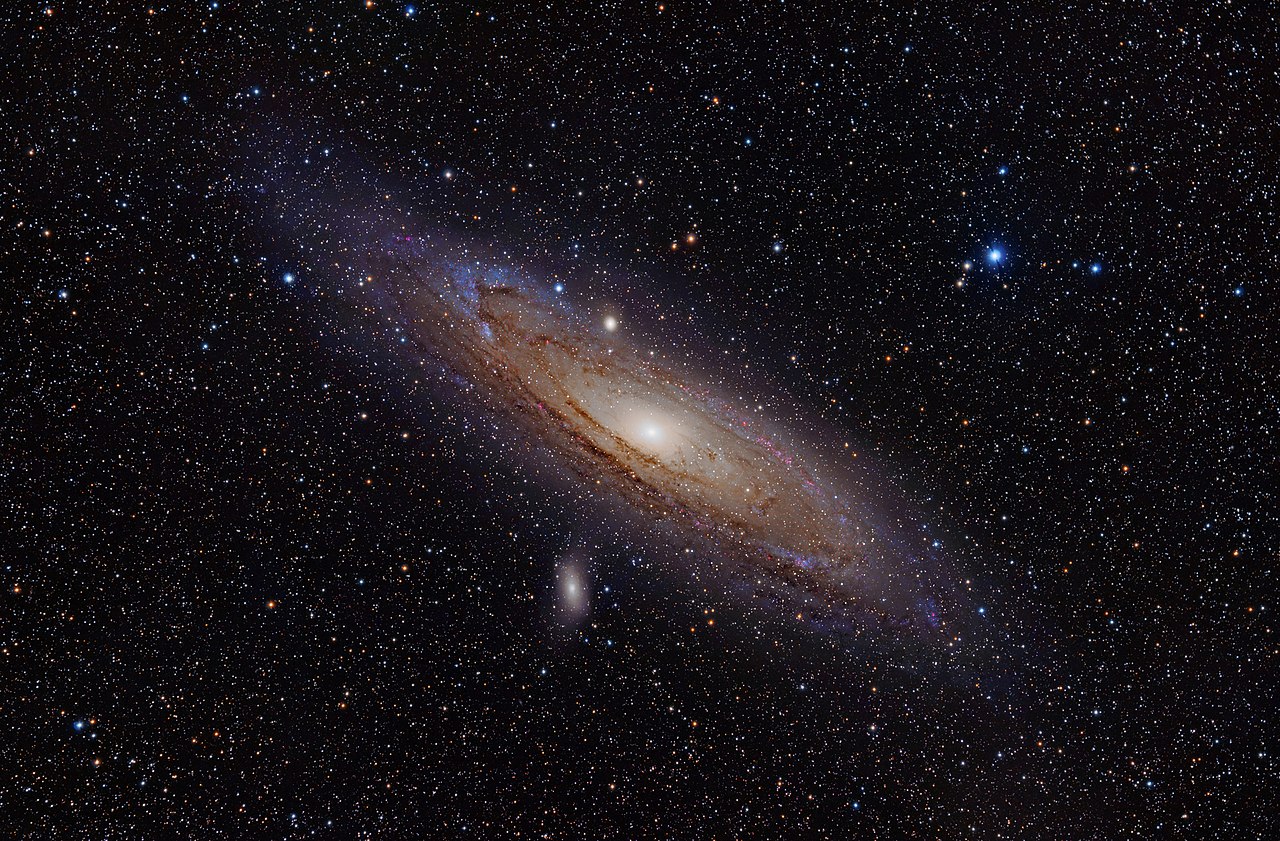
The Andromeda Galaxy — 2.5 million light-years away, and still less than 0.3% of the way to one billion. Credit: Adam Evans / Wikimedia Commons (CC BY 2.0)
📱 Space Technology Encyclopedia — Explore warp drives, light sails, and the physics of interstellar travel in our free app.
Download FreeOne billion light-years. Not a billion miles, not a billion kilometers — but a billion years of travel at the fastest speed the universe permits. To frame that scale: our entire Milky Way galaxy spans just 100,000 light-years. Our nearest large galactic neighbor, Andromeda, sits roughly 2.5 million light-years away. One billion light-years launches us deep into a universe of superclusters, cosmic voids, and structures so enormous they barely have names in everyday language. And yet, the most ambitious minds in physics and engineering refuse to call the journey impossible. Here's a breakdown of the technologies — some real, some theoretical — that scientists believe could one day carry us to such unimaginable distances.
Video: James Webb Space Telescope — An Overview of humanity's most powerful observatory, observing galaxies billions of light-years away. Credit: NASA
Section One: The Speed Wall — Why Rockets Will Never Get Us There
Light travels at 299,792 kilometers per second. Even at that speed — which no object with mass can actually reach — crossing one billion light-years would take one billion years. Now consider this: Voyager 1, the fastest human-made object ever launched into interstellar space, travels at roughly 17 kilometers per second. At that pace, it would take Voyager about 18 trillion years just to travel a single light-year. Our Sun won't even exist in 5 billion years.

Voyager 1 — humanity's fastest spacecraft, yet it would take trillions of years to reach even the nearest star. Credit: NASA/JPL
The fundamental problem is that chemical rockets — even nuclear-powered ones — are catastrophically slow on cosmic scales. They work beautifully within our solar system, but interstellar distances expose their limits completely. To reach a billion light-years on any meaningful timescale, we need to think outside the rocket altogether and consider technologies that are either at the edge of current engineering or deep in theoretical physics.
Section Two: Light Sails and Laser Propulsion — The Most Plausible First Step
The most credible near-term technology for extreme-speed travel is directed-energy propulsion — specifically, using powerful ground-based lasers to accelerate an ultra-thin reflective sail to a significant fraction of the speed of light. The Breakthrough Starshot initiative, announced in 2016 with $100 million in funding, aims to do exactly this: send gram-scale "nanocraft" to Proxima Centauri (4.2 light-years away) at roughly 20% the speed of light, arriving in about 20 years.

JAXA's IKAROS — the world's first successful interplanetary solar sail, proving that photon pressure can propel a spacecraft. Credit: JAXA (public domain)
Here are three key takeaways about laser-driven light sails:
- They require no onboard propellant — thrust comes from photon pressure applied by the laser array on the ground.
- At 20% the speed of light, traveling one billion light-years would still take five billion years — but the physics is proven and scalable in principle.
- The engineering challenges are real but solvable: beam focusing over vast distances, heat management, and miniaturizing instruments down to gram-scale payloads.
Video: NASA Science Live — Going Interstellar, exploring the scientific reality of reaching other stars and beyond. Credit: NASA
Want to go deeper on interstellar propulsion, warp drives, and the physics of cosmic travel? The Space Technology Encyclopedia app covers it all.
🚀 Get the App — Free on iOSSection Three: Going Deeper — Warping Space and Punching Through It
Laser sails are impressive, but they still play by the rules of conventional physics. To cross a billion light-years on any human-relevant timescale, we would need to cheat those rules — or more precisely, exploit loopholes that theoretical physics has left open. Two concepts stand out: the Alcubierre warp drive and traversable wormholes.
A Closer Look at the Alcubierre Warp Drive
In 1994, Mexican physicist Miguel Alcubierre proposed a radical idea: instead of moving a spacecraft through space, contract spacetime ahead of it and expand spacetime behind it. The ship itself sits in a flat "bubble" — it never locally exceeds the speed of light, yet it effectively surfs a wave of distorted spacetime at any speed. Einstein's equations technically allow this.

The Alcubierre warp metric: spacetime contracts at the front and expands at the rear, allowing the bubble to move at arbitrary speeds. Credit: AllenMcC. / Wikimedia Commons (CC BY-SA 3.0)
Follow these steps to build an intuition for how warp drives work:
- Step one — Visualize spacetime as a flat rubber sheet. Massive objects create dimples (gravity wells) in the sheet.
- Step two — Now imagine squeezing the sheet ahead of a marble and stretching it behind. The marble "moves" without friction through space itself.
- Step three — Scale this up: a spacecraft in an Alcubierre bubble could cross a billion light-years without the crew experiencing a single year of travel — if the physics can be engineered.
The catch? Both the warp drive and traversable wormholes require something called exotic matter — a substance with negative energy density that has never been confirmed to exist in macroscopic quantities. NASA physicist Harold "Sonny" White spent years exploring whether quantum effects could reduce the exotic matter requirements. The research is ongoing. It hasn't produced a working prototype, but it hasn't hit a hard wall either.
"The universe is under no obligation to make sense to you." — Neil deGrasse Tyson
Section Four: Practical Tips — How to Follow the Research Today
You don't need a PhD to track the most exciting ideas in this field. Here are a few concrete ways to stay informed and deepen your understanding:
Tip: Bookmark NASA's Innovative Advanced Concepts (NIAC) program at nasa.gov/niac. NIAC funds early-stage, potentially transformative concepts — including warp drive studies and laser sail development — and publishes all results publicly.
Video: James Webb Space Telescope's MIRI — the mid-infrared instrument that peers billions of light-years into the universe's history. Credit: NASA/ESA/CSA
Follow the Breakthrough Initiatives at breakthroughinitiatives.org — this is where laser-sail propulsion is being actively engineered, not just theorized. And if theoretical physics feels intimidating, start with special relativity before jumping to general relativity and wormhole geometry. Understanding why E = mc² matters is the perfect foundation for understanding why a billion light-years is both impossible and, perhaps someday, not.
Final Thoughts

The Hubble Ultra Deep Field — each speck of light is an entire galaxy, most sitting billions of light-years from Earth. This is where we are trying to go. Credit: NASA, ESA (public domain)
A billion light-years is the ultimate stress test for human ambition. Conventional rockets fail immediately. Light sails get us closer to the problem but not through it. Warp drives and wormholes offer the only theoretical routes on any meaningful timescale, and both hinge on exotic physics we haven't yet confirmed. But science has a reliable habit of turning "physically impossible" into "not yet engineered." Every leap — from fire to flight, from transistors to smartphones — started as an impossible idea held by a handful of stubborn optimists.
The tools that will carry humanity — or its machines — to a billion light-years away haven't been built yet. But the physics is being written. Which concept do you think is our most realistic path: laser-propelled sails, warp drives, or something we haven't imagined yet? Share your thoughts below.
Ready to explore further?
The Space Technology Encyclopedia app covers warp drives, light sails, exotic matter, and hundreds of other cutting-edge space topics — all in your pocket.
🚀 Download on the App Store
Nhận xét
Đăng nhận xét